Biography
William BECHTEL
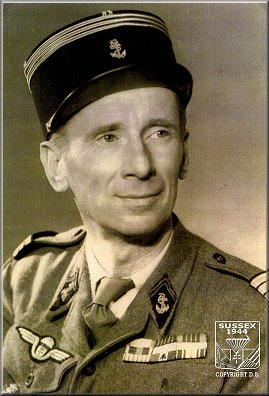
On 31 September 1944, William Bechtel was parachuted into France for operational and liaison missions for the OSS and SIS.
He flew at night with the British 161 Squadron under the leadership of Squadron Leader Hugh Verity.
William Bechtel took part in 15 Lysander missions and landed in France at night on 17 occasions.
When the Plan Sussex operation (OSS-5) was established, Kenneth Cohen called on his collaboration and asked him to organise the air operations as they developed.
Thus, as a member of OSS-5, he helped with the insertion and extraction of agents in occupied France.
Appointed second lieutenant on a permanent basis, he completed interpreter training placements at the Paris Military School from 1936 to 1938.
Self-employed from 1928, he made numerous trips to Germany and submitted reports to the 2nd Bureau concerning military-related activities (troop locations, etc.), especially from 1936 onward. His last “study” trip took place on 18 March 1939.
From 19 March, he was targeted by the police and arrested near Trier in the fortified zone where travel was prohibited. He managed to cross the border at Germanshof during the night of 19–20 March, despite the closure of that border post.
At the outbreak of war (September 1939), Bechtel was kept at the head of his factory as a special assignee for the manufacture of diphenylamine (a powder stabiliser). At his request, he was removed from this special assignment on 10 June 1940.
Placed at the disposal of the staff of the 1st Army, he decided on 13 June 1940 to destroy the installations of his factory in Igny (Seine-et-Oise), which could have been used by the enemy.
During the night of 13–14 June 1940, as the Germans were entering Paris, he drove to Laval after receiving from Captain Zundel (2nd Bureau) instructions and equipment to organise a sabotage network behind German lines.
Prevented from carrying out this task by the rapid advance of enemy forces and the disappearance of the officers who were to assist him, Bechtel—after hearing General de Gaulle’s appeal—decided to reach England. After twice slipping away from the Germans, he embarked on 26 June on a fishing boat at Longuivy near Paimpol and reached England.
On 1 July 1940, he signed up in London with the Free French Forces (enlistment no. 361 A). Appointed lieutenant on a permanent basis on 25 September 1940, he joined Bangui (French Equatorial Africa) and was assigned to the 2nd March Battalion of Oubangui-Chari.
With this unit, he took part in the Syria campaign, operations on the Euphrates, and the Libya campaign (notably at Bir Hacheim). Promoted to captain on 25 March 1943, he requested assignment to the BCRA in London, which he joined in September 1943.
On 1 October, he was assigned to Plan Sussex and sent to the British school at St Albans. In early December, he took parachute training at Ringway near Manchester.
During the night of 9–10 April 1944, he was parachuted into occupied France near Châteauroux with his radio operator. His mission: to report to Allied headquarters on enemy troop movements and German military installations in the Rouen sector.
Despite very great difficulties, he managed to bring his equipment and weapons back by bicycle from Chartres (where he had been dropped by mistake) to Rouen, where he set up his intelligence centre. They sent 52 messages to the Allies; Colonel Henderson described the mission as “first class”.
Information from messages no. 3 and no. 8 enabled the RAF to destroy a major fuel depot in Rouen (the Desmarais depot) and a complete V1 train at Formerie station.
Messages no. 33 and no. 41 (25 and 26 August) also enabled the RAF to strike heavily at Von Kluge’s army in retreat as it attempted to cross the Seine.
On 5 August 1944, Bechtel followed a German convoy by bicycle. Thrown into a shell crater during the bombing of the column, he suffered a fractured femoral neck but managed to save his transmitter. Hidden and then operated on in Rouen, he nevertheless resumed radio contact with the Allied reconnaissance aircraft from the very next night.
On 19 August, he received the following message from his superior: “We are very pleased to inform you that High Command considers your messages very accurate and valuable, and congratulates you.”
On 30 August, he was freed by a Canadian unit and taken to the Val-de-Grâce hospital (Paris). His condition required another operation. He received the Légion d’honneur with the citation: “An officer of remarkable courage… carried out his mission in the most ‘brilliant’ manner… Signed: De Gaulle.”
Treated at Val-de-Grâce, William Bechtel then left for Indochina as a battalion commander of Commando Conus from 20 July 1945 to 28 May 1946. He died in the summer of 1988.
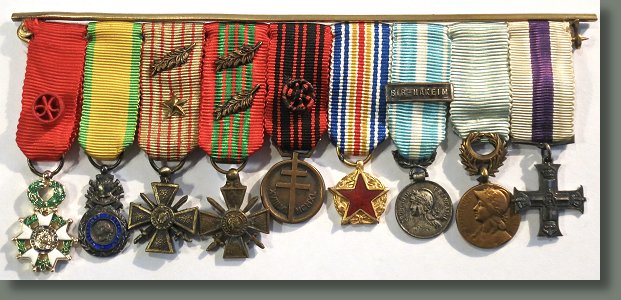
Main decorations
- Officer of the Légion d’honneur
- Officer of the Resistance
- Military Medal (World War I)
- War Cross 1914–1918 and 1939–1945 (multiple citations)
- Colonial Medal (Bir Hacheim clasp)
- Military Cross
Documents / Images
Click an image to open it full size.
Sources
“Souvenirs de Ch. Pérez et de L. Guyomard”, Revue de la France Libre, no. 265. © A. Casalis